
Mobile app
7 Stripes
168 hours of weather data on one screen
Say goodbye to endless scrolling. Now you can see everything you need to know at a glance, with the option to get highly-detailed weather info hour-by-hour.

Start-to-end solutions to unsolved problems.
Mobile app
168 hours of weather data on one screen
Say goodbye to endless scrolling. Now you can see everything you need to know at a glance, with the option to get highly-detailed weather info hour-by-hour.

Mobile app
Walk and hike at night
Uses the LiDAR sensor in iPhone Pro models to see in the dark, even total darkness. Red monochrome coloration protects your low-light vision, making it perfect for walking the dog at night, hiking, hunting or fishing, all without using a flashlight.

Mobile app
Never miss a moment
From the dawn of photography, there has been a dilemma: either review a photograph, or prepare to take another one. It was impossible to do both - until now. With an always-on viewfinder and simultaneous fullscreen review of your latest photo, Always Cam ensures you never miss a moment. Also, framing with a small viewfinder actually helps with composition, so your shots will look more professional.
Putting something into stasis has long belonged to science fiction. Quantum physics contains a tantalizing idea called the Quantum Zeno effect: under the right conditions, repeatedly checking whether a system has changed can suppress certain kinds of change. But applying that idea to real-world objects has always seemed wildly out of reach. Ordinary matter has too many moving parts — heat, chemistry, radiation, molecular motion, and countless microscopic processes — for simple “measurement” to freeze it.
Our project explores a speculative route around that problem using ideas inspired by dark-sector physics. In many theories beyond the Standard Model, hidden fields can form stable, localized structures called non-topological solitons. We ask whether such a soliton could act like a controlled bubble of new physics: a region where ordinary matter is coupled to a protective field environment that suppresses unwanted change.
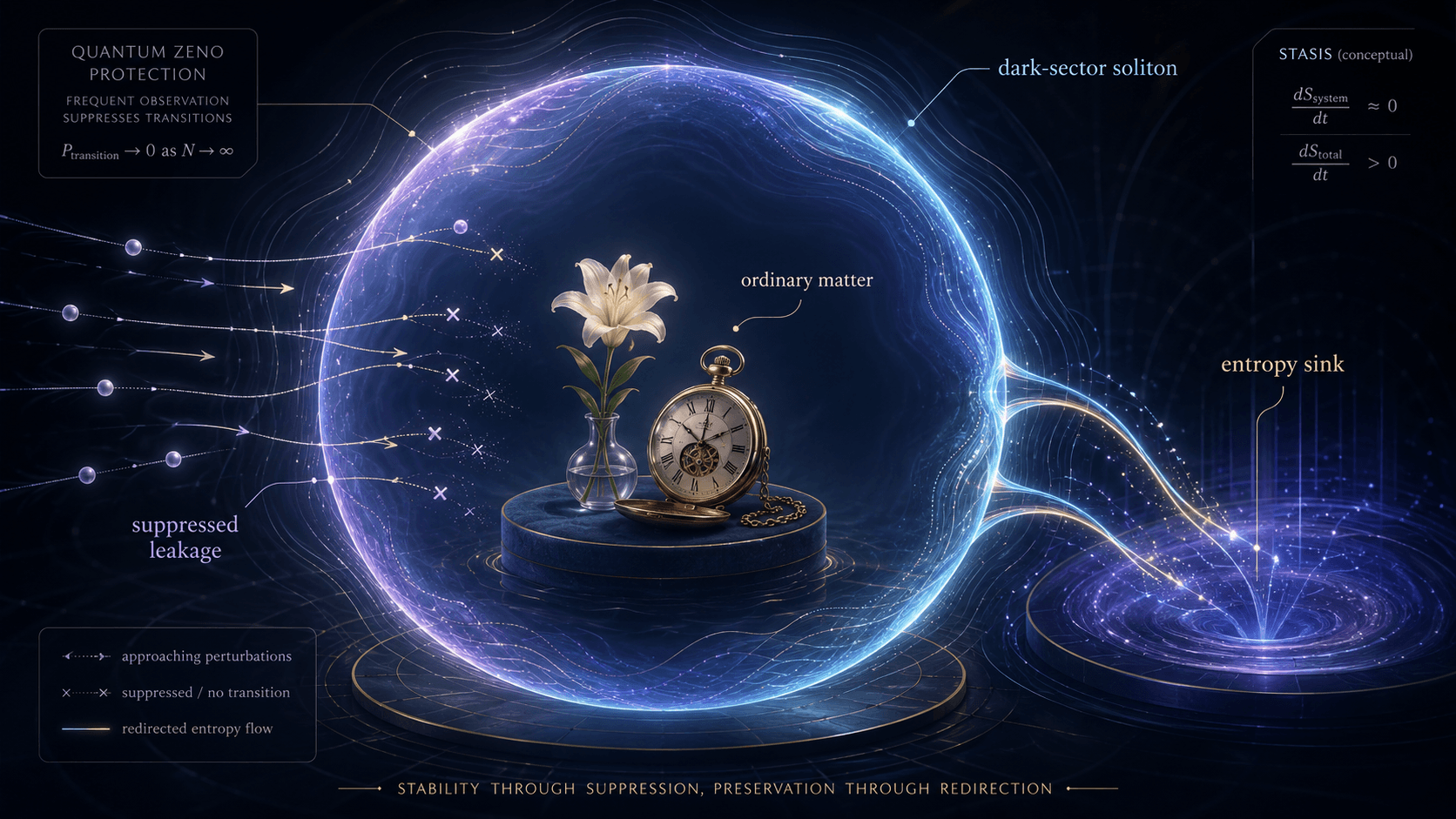
The result is not a stasis machine, and it is not an experimental claim. It is a mathematical and computational toy model. But within that model, we show that the required ingredients can be made mutually consistent: a stable room-scale soliton-like region, a protected matter sector, Zeno-style suppression of leakage, controlled coupling to ordinary matter, and an entropy sink that keeps the system from simply heating up.
We have published the simulator and supporting code online so others can inspect, challenge, extend, or replace the assumptions. The goal is to provide a foundation for exploring whether “stasis” can be translated from science fiction into a precise theoretical physics question.
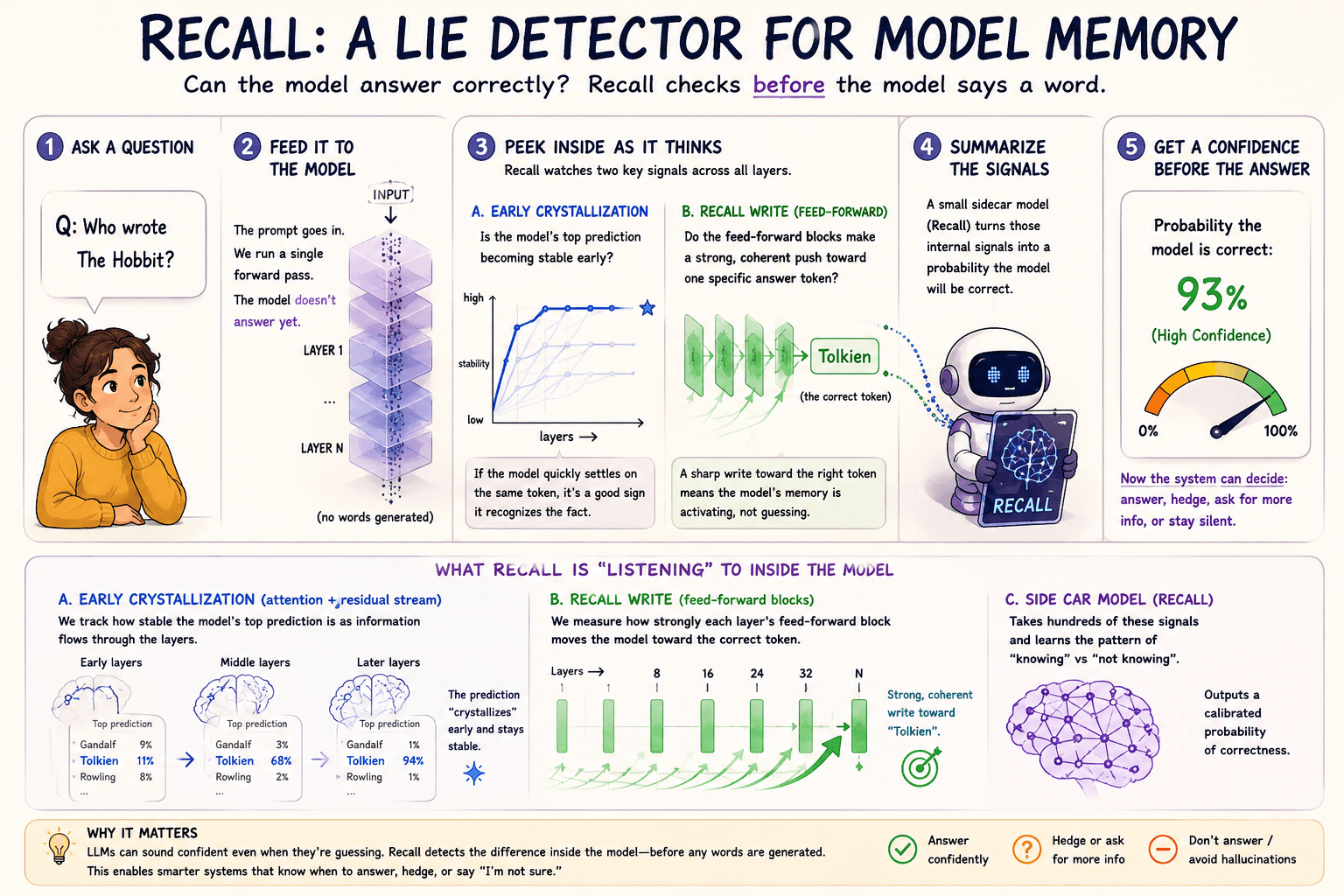
Recall is like a lie detector for model memory, but one that listens to the brain activity before the mouth opens. It does not ask, “Was the final answer right?” or “Did the model sound sure?” It asks whether the model’s own hidden machinery already contains enough evidence of a fact being retrieved.
That distinction matters because today’s AI systems can be fluent even when they are guessing. A tool like this points toward models that can check their own knowledge boundaries earlier, hedge when appropriate, and maybe even avoid hallucinations before they happen. The project also ships with an interactive app, precomputed features, evaluation metrics, and a reproducible pipeline for rebuilding the dataset and sidecar estimator.